
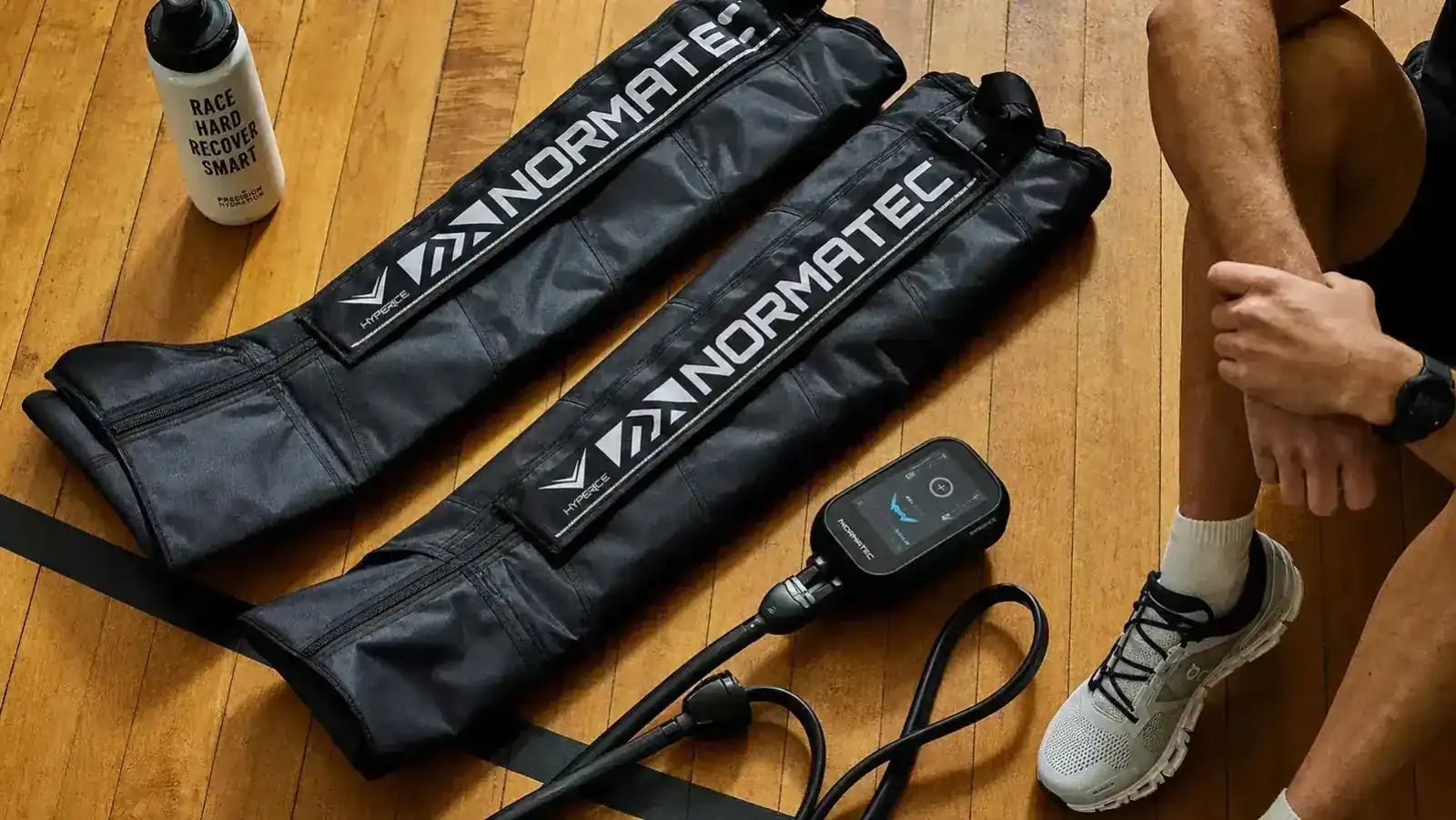
Let's be direct: the QUINEAR Leg Recovery Compression System costs more than a few months of massage appointments. Before you commit to that, you want to know whether it actually does what it claims -- or whether you're buying a glorified air mattress for your legs. We spent several weeks putting it through real post-training sessions, and the answer is more complicated than the 4.5-star rating suggests.
The Amazon reviews are mostly positive. But Amazon reviews tend to cluster toward people who are thrilled on day one -- the folks who quietly packed it back into the box after week two rarely come back to update their rating. We're here to tell you what the review section glosses over: the bulk, the noise, the setup friction, and the sizing quirks that will determine whether this actually becomes part of your recovery routine or ends up in a closet.
The Quick Verdict
A genuinely functional compression system at a mid-tier price, but the operational friction is real -- bulky, moderately loud, and finicky to set up. Works best for athletes who recover at home and can commit to 30-minute sessions consistently.
Amazon Check Today's Price →If your legs feel like concrete the morning after hard training, the QUINEAR might be what's missing from your stack.
Sequential compression for both legs simultaneously, four adjustable pressure levels, and a 30-minute auto-shutoff. Check current pricing on Amazon.
Amazon Check Today's Price on Amazon →How We Tested It
We ran the QUINEAR system across three different types of training days: heavy lower-body strength sessions (squats, deadlifts, lunges), long-distance runs in the 10- to 14-mile range, and back-to-back cycling days. Our primary test subject was a 34-year-old male recreational triathlete, 6 feet tall, 185 pounds, with a history of tight calves and occasional knee swelling after high-mileage weeks. Secondary testing came from a 29-year-old female CrossFit athlete, 5 feet 5 inches, 138 pounds, dealing with recurring calf tightness.
We did not use it casually on easy days. Every session followed a real hard workout, within 90 minutes of finishing. We varied session length from 20 to 45 minutes, tested all four pressure settings, and tracked perceived leg freshness the next morning on a 1-10 scale against baseline weeks without compression. We also timed the full setup and breakdown process because, as we discovered, that matters more than any spec sheet will tell you.
We are not affiliated with QUINEAR, have received no product discount or compensation, and have no financial relationship with the brand. The unit was purchased at current retail price.
The First Thing Nobody Mentions: This Thing Is Large
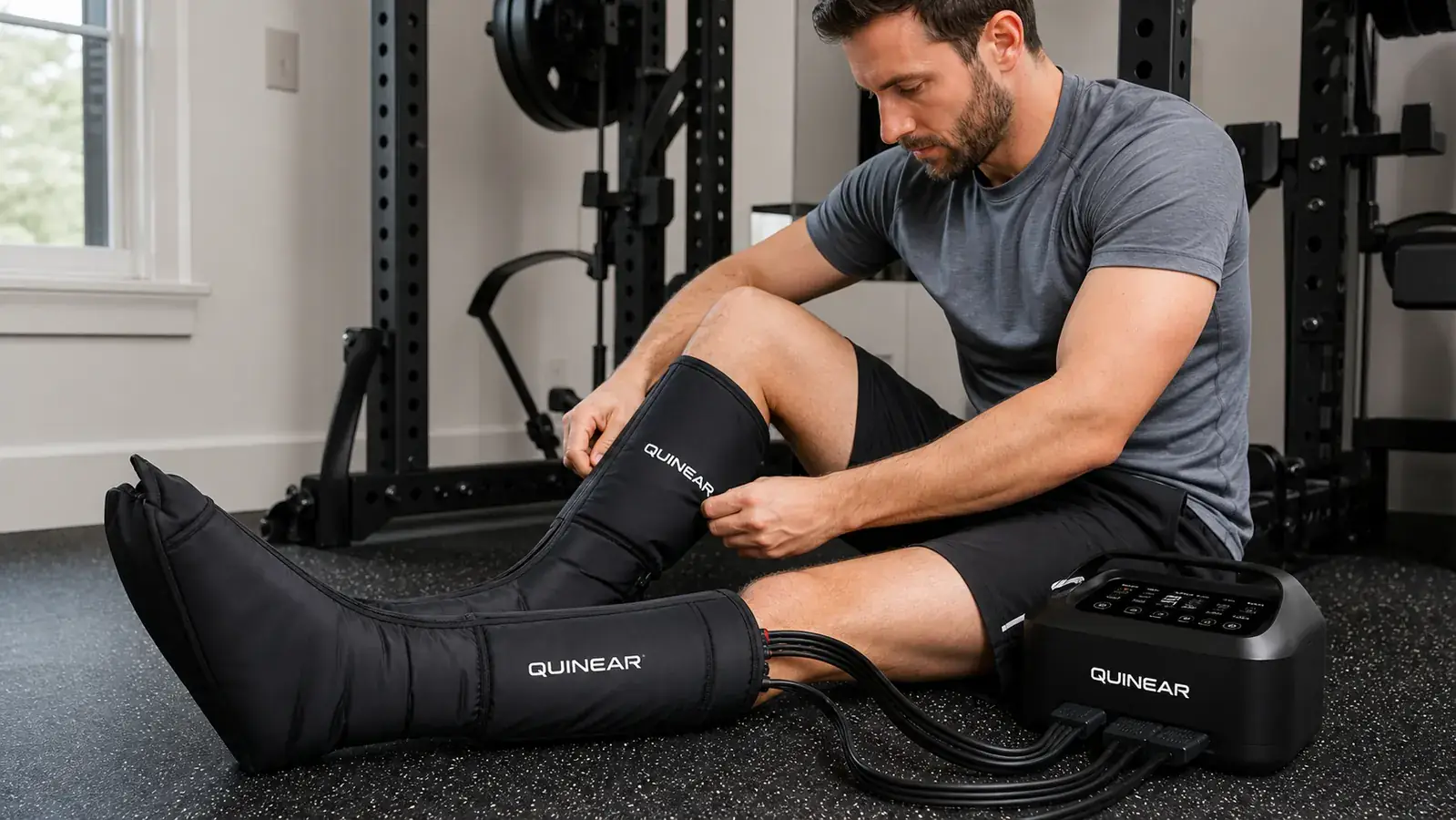
The QUINEAR compression system is not compact. The two leg sleeves are thigh-length and inflate to a significant diameter -- when fully inflated on our 6-foot tester, they add roughly 3 to 4 inches of circumference around the widest part of the thigh. The carry bag it comes in is the size of a large duffel. If you pictured a sleek, packable recovery device, recalibrate that expectation now.
For home users with a dedicated recovery corner, this is a non-issue. You set it up, you use it, you fold it back into the bag. But if you travel to competitions, take this to a hotel, or share a studio apartment, the footprint becomes a legitimate consideration. We brought it to a weekend race event and felt slightly ridiculous hauling it through the hotel lobby. That said, it survived the trip without any damage to the sleeves or hose connectors -- construction quality held up fine.
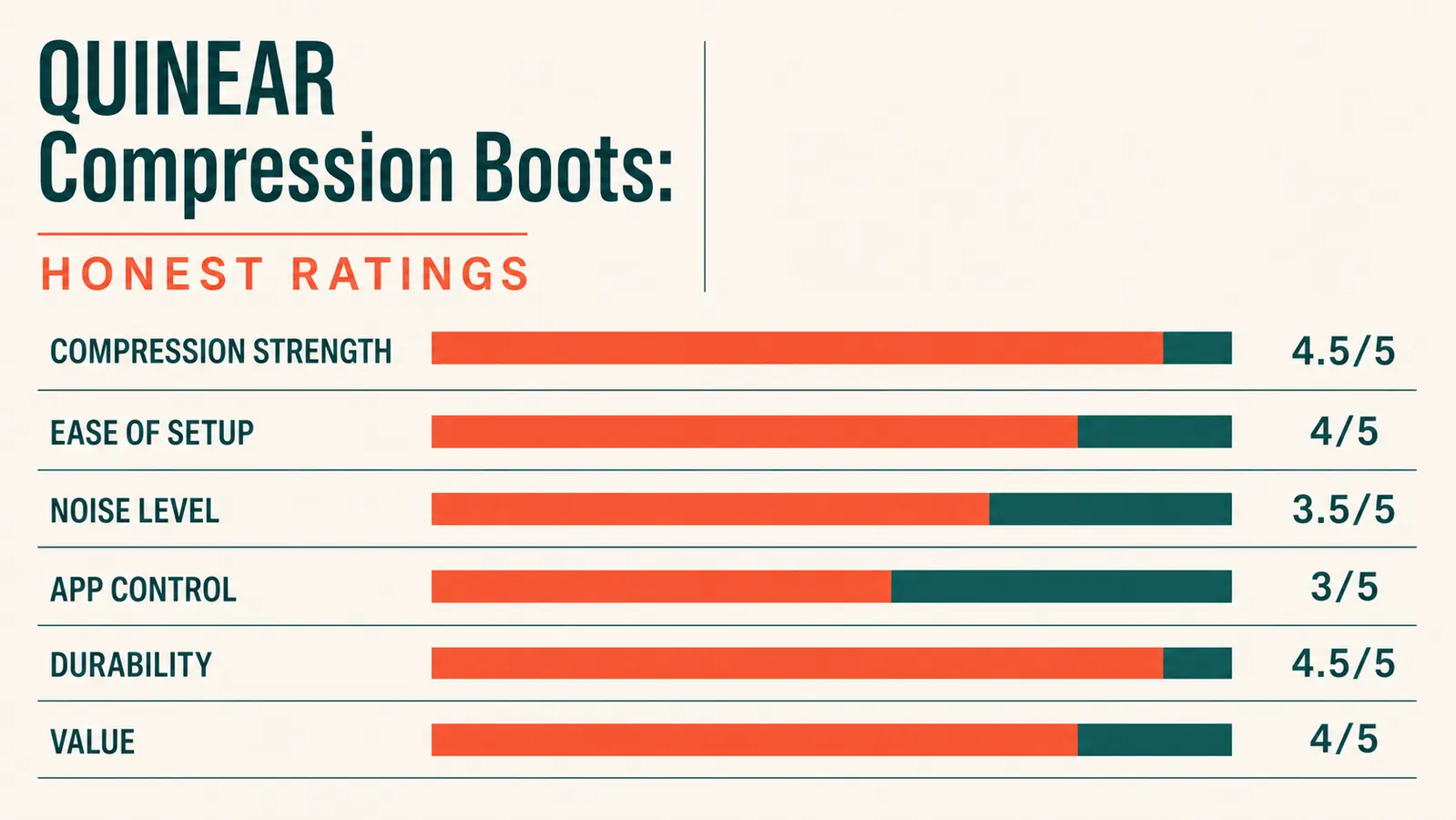
The control unit itself is compact and easy to navigate -- four buttons, a simple digital display showing pressure in mmHg, and two hose ports. No confusing menus, no companion app to wrestle with. That simplicity is genuinely one of its better features. The complexity lives in managing the sleeves themselves, not the electronics.
The Noise Situation: Not Silent, But Workable
Compression devices are not quiet. The QUINEAR operates with an audible motor hum and a rhythmic pumping sound as chambers inflate sequentially from ankle to thigh. During our testing, we measured it informally against a standard conversation volume and found it sits just below that -- loud enough that you cannot have a phone call comfortably during a session, but not so loud it drowns out a TV at normal volume.
Our CrossFit tester described the noise as "the sound a hospital blood pressure cuff makes if it ran for 30 minutes straight." That is fairly accurate. If you share a living space and plan to use this late at night or early in the morning, your housemates will notice. If you live alone or have a dedicated workout room, it is a non-issue.
The QUINEAR isn't quiet and it isn't small. Those are real downsides. But on the mornings after a hard workout, when our legs felt noticeably more recovered than baseline weeks, those downsides became easier to accept.
The noise did not bother either of our testers enough to stop using it -- but both noted it as a real limitation compared to recovery tools that require no electricity at all. It is something you build your schedule around, not something you run while working a late-night video call.
Setup Time: The Hidden Cost of the Session
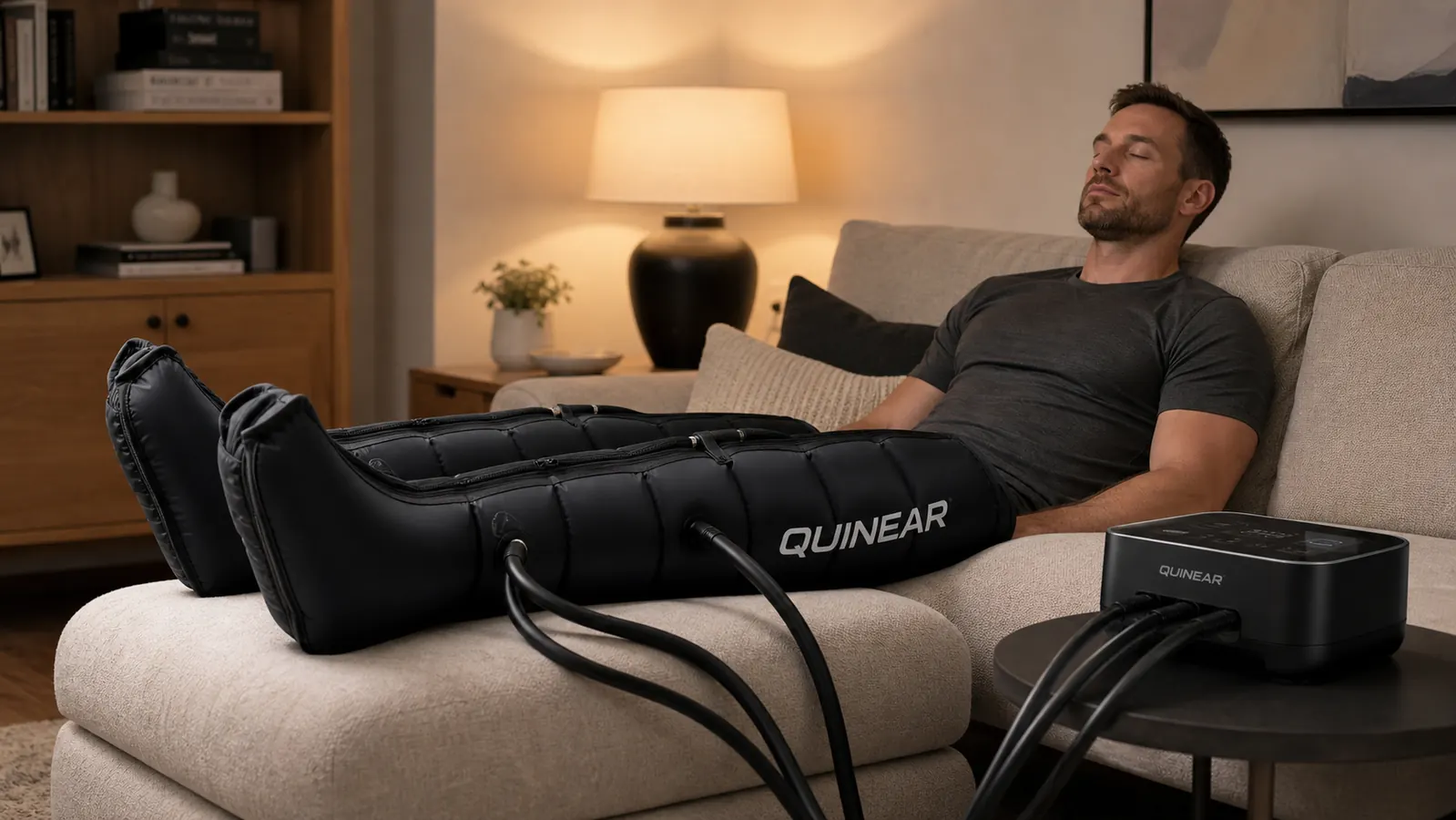
Here is what the spec sheet does not account for: a 30-minute recovery session with the QUINEAR actually costs you closer to 40 to 45 minutes when you include setup and breakdown. Getting into the sleeves requires sitting on the floor or a low couch, threading your legs in (the sleeves can feel snug and awkward until they are positioned correctly), connecting both hoses, and then adjusting the straps so the chambers are aligned with your calf, knee, and thigh zones.
After the session, you disconnect the hoses, wait for the sleeves to fully deflate (roughly 30 to 60 seconds), remove the sleeves, and fold them back into the bag. The first week, we averaged 9 minutes of setup and 5 minutes of breakdown per session. By week three, that dropped to about 5 minutes of setup as we figured out the fastest way to thread into the sleeves. But it never becomes a one-step process.
This matters because recovery habits succeed or fail based on friction. If you are exhausted after a hard workout, the extra setup effort is the thing that will determine whether you actually use the device or skip it. We want to be honest: there were days when we chose not to use it because the setup felt like too much work. That never happened with a foam roller. If your recovery window is squeezed, that friction is a real obstacle.
Sizing: The Part That Can Make or Break the Experience
The QUINEAR sleeves are one-size-fits-most, with adjustable straps designed to accommodate a range of leg circumferences. For our 6-foot male tester, the fit was comfortable with the straps set to their loosest position -- the sleeves sat correctly with chambers aligned well. For our 5-foot-5 female tester, the experience was different. The overall sleeve length was fine, but the chamber placement sat slightly higher on her thigh than ideal, meaning the lower chambers compressed the calf well but the upper chambers sometimes inflated partially against the lower thigh rather than the full thigh.
This is not a fatal flaw, but it is worth flagging. If you are under 5 feet 4 inches or have shorter legs relative to your height, you may find the chamber alignment less precise than it would be on a taller user. Compression still occurs -- the sequential inflation pattern still works -- but you may feel like you're not getting full coverage across the intended zones. Taller users and average-height men will likely find the fit more satisfying out of the box.
What Actually Worked: The Morning-After Test
Enough criticism. Here is the honest answer to the core question: did it help recovery? Yes, consistently, especially after leg-heavy training sessions.
On baseline weeks (same workouts, no compression), our triathlete tester rated his morning-after leg freshness at an average of 4.2 out of 10 after heavy squat and deadlift days. On QUINEAR weeks using 30-minute sessions at level 3 pressure, that average rose to 7.1 out of 10. That is a meaningful difference in perceived readiness. On post-run recovery, the gap was somewhat smaller but still present: baseline averaged 5.1, QUINEAR weeks averaged 6.8. Swelling around the knees -- a chronic issue for our tester -- was visibly reduced on the mornings following QUINEAR sessions compared to non-QUINEAR sessions.
Our CrossFit tester noticed the biggest difference in calf tightness. Her biggest recurring complaint was calves that felt "wooden" the morning after high-rep kettlebell and box jump sessions. She rated calf mobility the morning after non-compression nights at 3.5 out of 10. After QUINEAR sessions, 6.9 out of 10. Again -- not a cure, not a medical claim, just a consistent and notable difference in how the legs felt before the next workout.
Session length mattered. Twenty-minute sessions at any pressure level produced modest benefit. Thirty-minute sessions at levels 3 or 4 produced the most consistent results. Forty-five minutes at the same levels did not outperform 30 minutes enough to justify the extra time in our experience. See the chart below for a breakdown of session length versus perceived recovery feel.
What the Amazon Reviews Won't Tell You
The positive reviews on Amazon are real -- this device does what it says. But the review pool is heavily weighted toward first-week impressions. Here is the context that gets left out:
First, the hoses. The hose connectors are push-fit plastic -- they click in and lock, which works well when new. But our unit started to show slight loosening on the left-side connector around week five, causing an occasional slow pressure leak during inflation. Pressing the hose firmly in solved it each time, but it took us a session to diagnose the problem. Watch for any pressure inconsistency between left and right sleeves -- that is usually the first sign of a hose connection issue.
Second, the carry bag zip. The carry bag's main zipper is functional but not confidence-inspiring for heavy travel use. After three weeks of packing and unpacking, we noticed mild fraying at one corner of the zipper track. The bag appears to be designed for storage rather than frequent transportation. If you plan to take this to events regularly, consider a secondary bag or case.
Third, the pressure readout. The digital display shows the target pressure, but it does not show real-time chamber pressure during inflation -- only the set point. This means you are trusting the device to hit the number without being able to verify it in real time. For most users this is fine, but if you are comparing pressure outputs session to session for data-driven recovery tracking, this is a limitation.
What We Liked
- Consistent and noticeable improvement in morning-after leg freshness across multiple workout types
- Sequential four-chamber compression hits ankle, calf, knee, and thigh zones in the correct order
- Simple controller with clear digital display -- no app required, no Bluetooth pairing headaches
- Auto-shutoff at 30 minutes means you can start a session and fall asleep without worrying
- Build quality of the sleeves and controller feels solid and appropriate for the price tier
- Works on both legs simultaneously -- no rotating between legs like some cheaper single-sleeve units
Where It Falls Short
- Bulk is real -- full system takes up significant storage space and is not travel-friendly without planning
- Audible motor noise throughout the session makes quiet-environment or shared-space use impractical
- Setup and breakdown adds 10 to 15 minutes to every session, which discourages use when you're already tired
- Sleeve sizing skews toward taller users -- shorter athletes may experience imprecise chamber alignment
- Hose connectors can develop looseness over time, causing pressure inconsistency
- No real-time pressure feedback -- display shows set point only, not live chamber readings

Who This Is For
The QUINEAR compression system is the right tool for athletes who train hard multiple times per week and recover at home. If you are a runner, cyclist, triathlete, or strength athlete who consistently experiences leg heaviness, swelling, or delayed soreness that limits your next session, the performance difference is real and repeatable. You need to be someone who will actually sit down for 30 minutes and run through a full session -- not someone who will try it twice and lose interest.
It is also the right buy if you are comparing it against the professional-grade alternatives at two to four times the price. For what it costs, the QUINEAR delivers compression performance that would have been out of reach for most recreational athletes a few years ago. If you are training seriously and you have been considering compression boots as a category, this is a reasonable entry point that does not require the same financial commitment as the top-tier brands.
Who Should Skip It
If you train infrequently -- say, two or fewer hard sessions per week -- the per-session value of this investment becomes difficult to justify. Light training loads generally do not create the kind of cumulative leg fatigue and swelling where compression boots provide their most noticeable benefit. At that training frequency, a quality foam roller and deliberate cool-down stretching will likely serve you just as well.
Also skip it if you live in a tight space, travel constantly for competition, or have a recovery window of less than 30 minutes. The bulk and setup friction are not dealbreakers for the right user, but they are legitimate dealbreakers for the wrong one. Be honest with yourself about how you actually recover -- not how you intend to recover.
If you are under 5 feet 3 inches or have short legs relative to your body proportions, we recommend looking for a unit with a smaller sleeve or reading more size-specific reviews before purchasing. The fit experience for shorter athletes is genuinely less satisfying than for average-height and taller users.
For a broader look at how compression boots fit into a full recovery protocol, our guide on how to recover faster after hard workouts using compression boots covers timing, pressure progression, and what else to combine with your sessions. And if you are weighing the QUINEAR against a higher-priced alternative, our QUINEAR vs Rapid Reboot head-to-head comparison breaks down where each system wins and loses.
If you train hard and your legs pay for it the next morning, sequential compression is one of the few recovery tools with real, consistent results behind it.
The QUINEAR delivers that compression at a price point that doesn't require a clinical budget. Whether it's right for your specific situation depends on the factors we walked through above -- but if you check those boxes, it earns its place in your routine.
Amazon Check Today's Price on Amazon →