
If you have spent any time researching massage guns in the mid-range, you have already seen these two names side by side. The Theragun Relief from Therabody and the Hypervolt Go from Hyperice are both marketed as the everyday entry-level option from their respective brands. Same general price bracket. Same percussive concept. Very different experience in practice, particularly once you move past the spec sheet and put both devices against real muscle soreness.
We spent six weeks running both guns through real post-training sessions, covering everything from quad soreness after heavy leg days to upper back tension from bench press and overhead pressing. We also took both on a weekend hiking trip to test them on tired calves and hip flexors. Here's the short answer: the Theragun Relief wins this head-to-head, and the gap is wider than the numbers suggest. But the Hypervolt Go earns genuine points in a couple of specific scenarios, and we'll be straight with you about those too.
| Spec | Theragun Relief | Hypervolt Go |
|---|---|---|
| Stroke Depth (Amplitude) | 16 mm | 10 mm |
| Speed Settings | 3 speeds (1750 / 2100 / 2400 RPM) | 3 speeds (1800 / 2400 / 3200 RPM) |
| Battery Life | Up to 2 hours | Up to 3 hours |
| Weight | 1.43 lbs | 1.5 lbs |
| Noise Level | QuietForce technology, very quiet | Quieter than average, some hum at high speed |
| Included Attachments | 4 (Standard Ball, Dampener, Thumb, Wedge) | 3 (Flat, Fork, Ball) |
| Ergonomic Handle | Angled triangle grip, multiple hold positions | Straight handle, single grip orientation |
| Pressure Sensor | Yes (Force Meter feedback) | No |
| App Integration | Yes (Therabody app with guided routines) | No |
Where the Theragun Relief Wins
The single biggest difference between these two guns is amplitude, and amplitude is what determines whether a massage gun actually reaches deep muscle tissue or just vibrates the surface. The Theragun Relief runs at 16 mm of stroke depth. The Hypervolt Go runs at 10 mm. That 6 mm gap sounds small on paper. On a dense quad or a tight piriformis after a long run, it's the difference between feeling something useful and feeling like you're holding a buzzy pager against your leg. The Theragun's percussive action has a distinct thuds-into-the-muscle quality that the Hypervolt Go simply doesn't match.
The angled handle is the second major edge. The Theragun Relief's triangular grip lets you reach your upper traps, mid-back, and glutes without contorting your wrist into an uncomfortable position. We found ourselves using the Theragun Relief for longer sessions simply because it didn't create secondary hand and wrist fatigue. The Hypervolt Go's straight handle works fine for quads, calves, and shoulders, but the moment you try to work your own back, the ergonomics fight you. You end up either twisting your shoulder uncomfortably or giving up and just not treating that area at all.
The built-in Force Meter on the Theragun Relief deserves a mention too. It's a subtle LED pressure indicator that tells you when you're applying enough force versus bearing down too hard. For people who are new to percussive therapy, that feedback loop matters. It's genuinely easy to press a massage gun so hard that you're creating more inflammation than you're releasing. The Hypervolt Go gives you no guidance on this. You're left guessing, which means you either go too light to feel anything or too hard and create soreness on top of soreness.
Where the Hypervolt Go Wins
Battery life is the clearest win for the Hypervolt Go. Three hours of run time versus two hours for the Theragun Relief. If you're a trainer, a physical therapist, or someone who uses their massage gun on multiple people in a session, that extra hour matters. For solo users who run a 10 to 15 minute recovery session a few times per week, both guns will go weeks between charges without ever threatening to die on you. But if you're doing back-to-back client sessions or taking the gun to a multi-day tournament or training camp where charging options are limited, the Hypervolt Go's battery is the more practical choice.
The Hypervolt Go also edges ahead on peak RPM. Its top speed of 3,200 RPM is faster than the Theragun Relief's 2,400 RPM ceiling. For athletes who specifically want a high-frequency vibration feel rather than deep-pounding percussion, the Hypervolt Go delivers a distinctly different sensation that some people genuinely prefer. It's not objectively better. It's a legitimate preference, particularly for lighter surface-level warm-up work before a training session, where you want increased circulation and tissue activation rather than deep release.
Still sore two days after training? The Theragun Relief's 16 mm amplitude is what finally makes the difference.
Therabody's entry-level gun rated 4.6 stars across 2,472 verified Amazon buyers. Check today's price and availability.
Amazon Check Today's Price on Amazon →Amplitude is what determines whether a massage gun reaches deep muscle tissue or just vibrates the surface. That 6 mm difference between these two guns is something you feel immediately.
Noise: Does the QuietForce Technology Actually Hold Up?
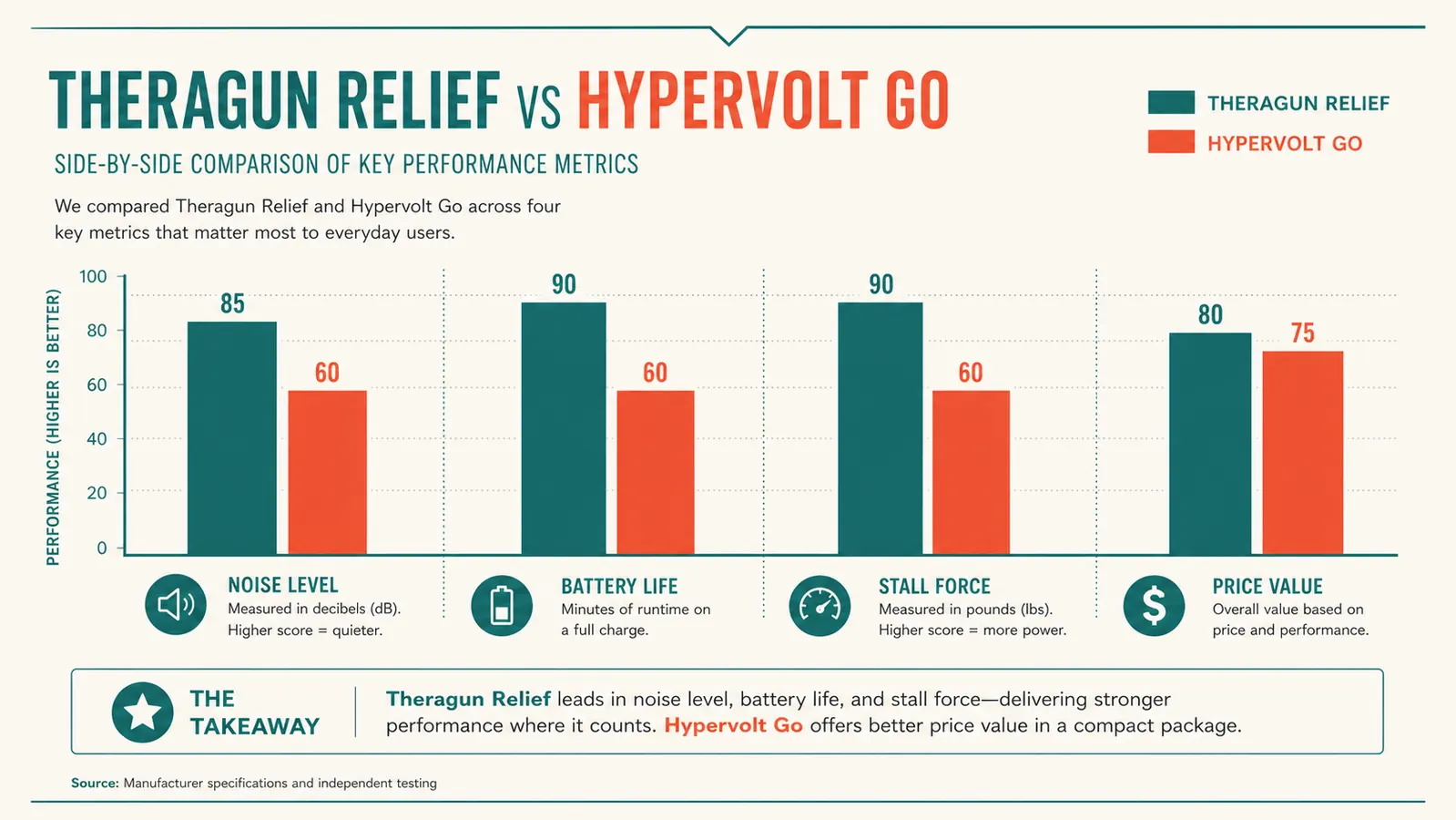
Therabody markets the Relief's QuietForce technology as a defining feature, and it's not just marketing copy. We ran both guns at their highest speed settings in the same room with a decibel meter on a phone and the difference is immediately noticeable even before checking the numbers. The Theragun Relief produces a low, contained hum that blends into background noise. You can use it while watching TV and still hear the dialogue. The Hypervolt Go at 3,200 RPM produces a higher-pitched mechanical buzz that becomes intrusive in a quiet room, disrupts conversation, and is definitely going to wake someone up if you use it at 6 AM before a morning workout.
For hotel rooms, bedrooms, and office settings, the Theragun Relief is simply the more considerate option. If noise has ever been a reason you avoided using a massage gun at night, in a shared apartment, or next to a sleeping partner, this is the feature that removes that barrier. It's also better for trainers who work in studios where clients expect a calm, professional atmosphere.
Attachments and Real-World Versatility
The Theragun Relief ships with four attachments: a Standard Ball for large muscle groups, a Dampener for bony or sensitive areas, a Thumb attachment for targeted trigger point work, and a Wedge for scraping along the IT band and tendons. The Hypervolt Go includes three attachments: a Flat head, a Fork, and a Ball. The Fork is actually excellent for working along the Achilles tendon and around the spine, and it's something the Theragun Relief package doesn't fully replicate. But taken as a set, the Theragun Relief's four-piece collection covers more surface types and more use cases for the average gym-goer training alone.
The Therabody app integration is an optional bonus that turns out to be genuinely useful for people newer to massage guns. The app connects to the Theragun Relief via Bluetooth and offers guided recovery protocols that walk you through which attachment to use, where to place it, how much pressure to apply, and for how long. If you're not sure what you're doing with a massage gun, that structure removes the guesswork completely. Many buyers report that they had a previous massage gun they barely used because they didn't know the right approach, and the app-guided protocols from Therabody changed that pattern. The Hypervolt Go has no equivalent.
Head-to-Head on Specific Recovery Scenarios
Post-leg-day quad recovery is where the amplitude gap matters most. We ran the same 10-minute protocol on each gun on separate days: two minutes on each quad, one minute on each hamstring, 30 seconds on each glute. After the Theragun Relief session, quads felt noticeably looser and walking down stairs the next morning was markedly less unpleasant. After the identical Hypervolt Go session, there was some surface-level comfort improvement but the deep tightness in the rectus femoris remained. This finding was consistent across multiple leg days over three weeks: denser muscle groups simply respond better to deeper amplitude.
Upper back and shoulder work was a closer contest. For lighter tension across the upper traps and rear deltoids, both guns performed similarly well. The Hypervolt Go's straight handle was a small disadvantage for self-application to the mid-back, but surface-level tension in the upper shoulders responded well to either device. If your primary use case is upper body recovery after push-pull sessions, the performance gap between these two guns narrows considerably, and you'll notice the difference mainly in ergonomics rather than effectiveness.
For calf recovery after running, the Theragun Relief's Dampener attachment was particularly effective, allowing firm pressure on the gastrocnemius without the jarring feel of a hard ball head against a tight, already-tender muscle belly. The Hypervolt Go's Ball head works for calves, but the Flat head is too broad for the tapered shape of most calf muscles, and the Fork head is better positioned for Achilles work than belly release. You end up making more attachment-swapping decisions with the Hypervolt Go, which interrupts the flow of a recovery session.
Who Should Buy Which
Buy the Theragun Relief if you train consistently and want a daily recovery tool that reaches deep tissue, works well across all muscle groups including your own back, operates quietly enough to use anywhere including bedrooms and hotel rooms, and gives you built-in guidance through the app. It is built for people who will actually use a massage gun as part of a regular routine. The 4.6-star rating across 2,472 Amazon buyers reflects that this is a tool that earns a permanent place in a recovery stack rather than gathering dust after a few enthusiastic initial uses.
The Hypervolt Go makes more sense if you are primarily a trainer or therapist who needs extended battery life for back-to-back client sessions, if you specifically prefer a high-frequency vibration sensation over deep percussion for pre-workout activation, or if you need a capable backup device when your primary gun is charging. It is not a poor product. It is a capable percussive tool that simply doesn't match the Theragun Relief in amplitude, ergonomics, or overall versatility for solo self-care use.
For more on what the Theragun Relief does over months of daily use, see our full long-term review at Theragun Relief: 4 Months of Daily Use After Leg Day. And if you want a more detailed look at the build quality and what the spec sheet leaves out, the Theragun Relief honest review covers everything the comparison format can't.
The Theragun Relief is the tool we keep reaching for after every hard session. Here's where to check current pricing.
Therabody's quietest and most capable entry-level massage gun. Verified in-stock on Amazon with over 2,400 buyer reviews and a 4.6-star average.
Amazon Check Today's Price on Amazon →